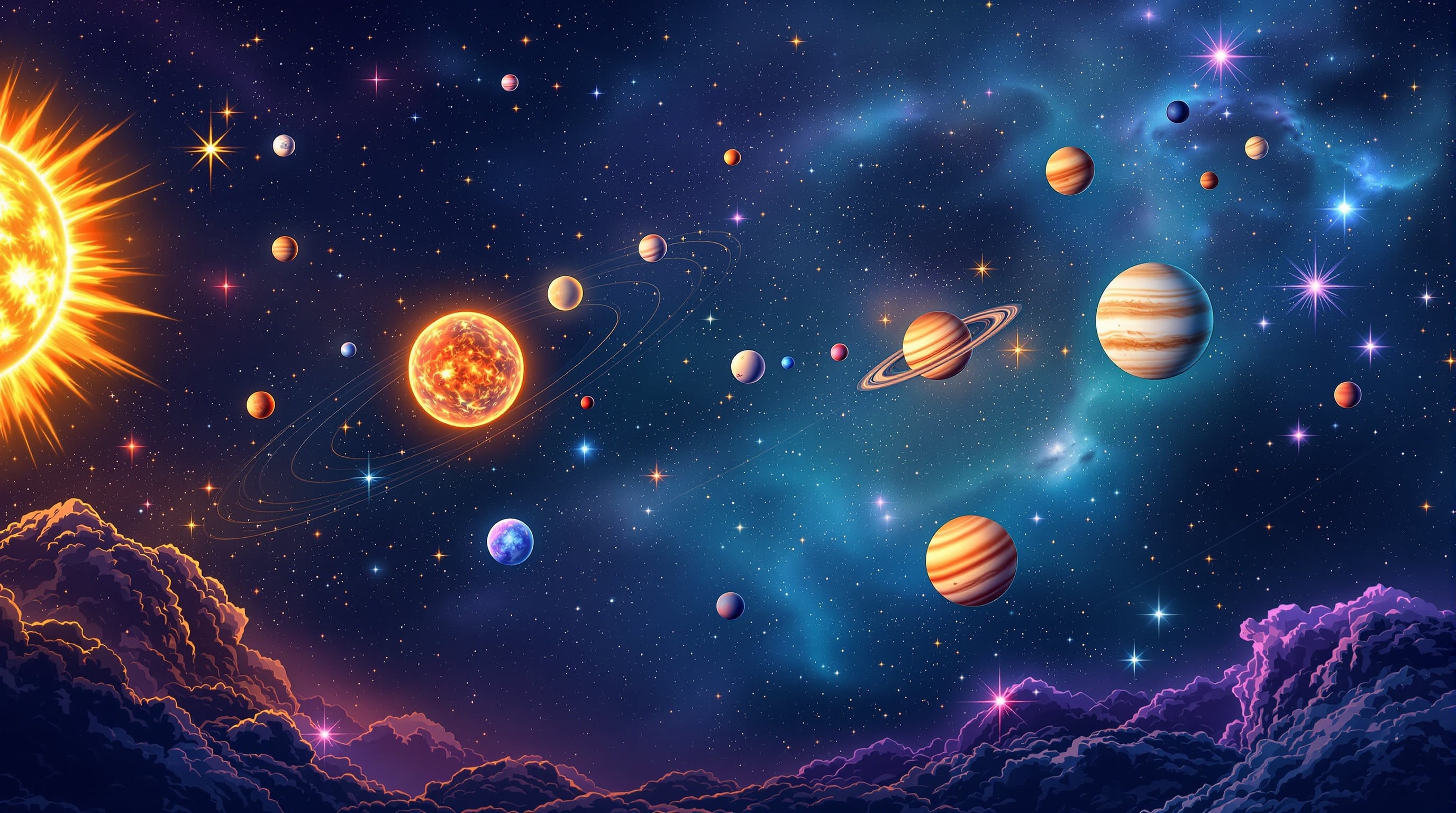
The Personal Planets (Sun, Moon, Mercury, Venus, Mars)
The personal planets move quickly through the zodiac and describe your individual personality traits, desires, and everyday behaviors. These five celestial bodies—the Sun, Moon, Mercury, Venus, and Mars—form the core of who you are on a personal level. Unlike the slower-moving outer planets that define generational themes, the personal planets are uniquely yours, creating the distinct flavor of your character.
The Sun represents your core identity, ego, and vital life force. It's your conscious will, creative expression, and the qualities you're developing throughout your lifetime. The Sun governs your sense of purpose, confidence, and how you shine in the world. Its sign placement describes your essential nature, while its house position shows where you're meant to make your mark. Solar energy is masculine, active, and radiant—it's the "I am" at the center of your being.
The Moon governs your emotional nature, instincts, and unconscious patterns. It represents your inner child, your need for security, and how you nurture yourself and others. The Moon changes signs every 2.5 days, making it highly personal. Its placement reveals what makes you feel safe, your habitual reactions, and your relationship with the feminine. Unlike the outward-facing Sun, the Moon is your private, receptive self—the emotional foundation upon which your personality rests.
Mercury rules communication, thinking, and information processing. It governs how you learn, speak, write, and make connections between ideas. Mercury changes signs every 3-4 weeks and is never more than 28 degrees from the Sun in your chart. A Mercury in Gemini thinks quickly and loves variety, while Mercury in Capricorn is methodical and strategic. Mercury also rules short trips, siblings, and your immediate environment. It's the messenger, connecting your inner world with outer expression.
Venus represents what you value, love, and find beautiful. It governs romantic attraction, aesthetic preferences, money, and pleasure. Venus describes your relationship style and what brings you joy. Venus in Taurus values stability and sensual comfort, while Venus in Aquarius seeks intellectual connection and freedom. This planet also rules your sense of worthiness and self-esteem. Venus spends about 4-5 weeks in each sign (though it can be longer during retrograde periods), making it a significant personal indicator.
Mars is your drive, ambition, and how you take action. It represents your assertiveness, sexuality, and anger. Mars shows how you pursue desires and defend yourself. A Mars in Aries is direct and aggressive, while Mars in Pisces is indirect and intuitive. This planet governs your physical energy, competitive spirit, and courage. Understanding your Mars placement helps you channel your desires effectively and manage conflict constructively.
The Social Planets (Jupiter, Saturn)
Jupiter and Saturn are called the social planets because they bridge personal and collective experience. They move more slowly than personal planets but faster than the outer planets, spending about one to two years in each sign. These planets describe how you relate to society, success, and responsibility.
Jupiter is the planet of expansion, growth, and good fortune. Known as the "Great Benefic" in traditional astrology, Jupiter brings opportunities, optimism, and abundance. It represents your belief systems, higher education, long-distance travel, and philosophical outlook. Jupiter's sign shows how you seek meaning and growth, while its house position indicates where you experience luck and expansion. Jupiter in Sagittarius loves adventure and philosophy, while Jupiter in Virgo finds growth through service and improvement. This planet encourages you to reach beyond your current circumstances and embrace life's possibilities.
Saturn is the planet of structure, discipline, and limitation. Called the "Great Malefic" traditionally, Saturn is actually a wise teacher who builds character through challenges. It represents responsibility, authority, time, and karmic lessons. Saturn shows where you face obstacles and must develop mastery through hard work. While Jupiter expands, Saturn contracts and focuses. Saturn in Capricorn feels naturally comfortable with authority and structure, while Saturn in Pisces struggles to create boundaries. The areas Saturn touches in your chart are where you'll work hardest but ultimately achieve your greatest accomplishments.
Together, Jupiter and Saturn represent the cycle of expansion and contraction, optimism and realism. Their interaction in your chart and through transits describes the rhythm of your growth and consolidation. Every 20 years, Jupiter and Saturn conjoin, marking significant societal shifts and personal turning points.
The Outer Planets (Uranus, Neptune, Pluto)
The outer planets move so slowly that they spend years in each zodiac sign, making them generational influences. Everyone born within several years shares the same outer planet sign placements. Rather than describing personal characteristics, these planets represent collective themes and mark significant life transformations through their house positions and aspects to personal planets.
Uranus takes 84 years to orbit the Sun, spending about seven years in each sign. It represents revolution, innovation, and sudden change. Uranus breaks down outdated structures and liberates us from restrictions. It governs technology, astrology, electricity, and all things avant-garde. Uranus is the rebel, the genius, the awakener. In your chart, Uranus shows where you're unconventional and where unexpected changes occur. A Uranus transit often brings shocking events that ultimately free you from limiting situations. The famous "Uranus opposition" around age 42 is a midlife awakening that demands authenticity.
Neptune orbits the Sun every 165 years, spending approximately 14 years in each sign. It represents spirituality, imagination, dreams, and illusion. Neptune dissolves boundaries, connecting us to universal consciousness and infinite compassion. It rules film, photography, music, and all arts that transcend ordinary reality. Neptune's energy is mystical but can also be confusing and deceptive. In your chart, Neptune shows where you seek transcendence, but also where you might experience confusion or escapism. Neptune transits often involve spiritual awakening, creative inspiration, or encounters with deception that ultimately teach discernment.
Pluto takes 248 years to complete its orbit, spending between 12 and 31 years in each sign due to its elliptical orbit. It represents transformation, death and rebirth, power, and the unconscious. Pluto strips away what's superficial to reveal essential truth. It governs psychology, sexuality, shared resources, and all that's hidden. Though small and distant, Pluto's influence is profound and intense. In your chart, Pluto shows where you undergo deep transformation and confront your shadow. Pluto transits are rarely comfortable but always evolutionary, forcing you to release what no longer serves and emerge transformed.
Retrograde Planets: A Time for Reflection
Planets periodically appear to move backward in the sky from Earth's perspective—a phenomenon called retrograde motion. While planets aren't actually moving backward, this optical illusion has significant astrological meaning. When a planet is retrograde, its energy turns inward, becoming more introspective and internalized.
Mercury retrograde, occurring three times yearly for about three weeks, is the most famous. During these periods, communication, technology, and travel often experience disruptions, encouraging us to review, revise, and reconsider. Venus and Mars retrograde periods affect relationships and actions respectively, slowing down these areas for necessary reflection. The outer planets retrograde for several months each year, creating extended periods for internal processing of their transformative energies.
If you were born with a retrograde planet in your chart, that planet's energy is more internalized and reflective. A retrograde Mercury might make you a deep thinker who carefully considers words before speaking. Retrograde Venus might make you introspective about values and relationships. Rather than being a disadvantage, natal retrograde planets often indicate areas where you've developed unusual wisdom through internal contemplation.
Finding the Planets in Your Birth Chart
On your birth chart wheel, planets are marked with their astronomical symbols: the Sun (circle with dot), Moon (crescent), Mercury (circle with cross and crescent), Venus (circle with cross below), Mars (circle with arrow), Jupiter (stylized "4"), Saturn (stylized "h"), Uranus (circle with cross and arrows), Neptune (trident), and Pluto (PL or circle with cross). Each planet will appear somewhere on the wheel, showing both its zodiac sign and house position.
Most chart printouts include a table listing each planet's exact position by sign and degree. This makes it easy to identify your placements without decoding symbols. Modern astrology software color-codes planets or creates clear legends. Start by identifying where each planet falls, then read about that planet in that particular sign to understand how that planetary energy expresses in your life.
Pay attention to which planets form aspects (geometric angles) with each other, as these relationships add nuance. A Venus-Mars conjunction suggests passionate romantic expression, while a Venus-Saturn square might indicate caution or restriction in love. The combination of sign, house, and aspects creates a complex picture of how each planetary energy operates uniquely in your life.
Understanding the planets is fundamental to astrological literacy. Each represents a distinct psychological function and life principle. By studying where these cosmic actors appear in your birth chart and how they interact, you gain profound insight into the diverse energies shaping your personality, relationships, and life journey. The planets are your cosmic toolkit—learning to use each one consciously empowers you to navigate life with greater awareness and intention.
Planetary Dignities: Planets in Their Home Signs
Each planet has zodiac signs where it functions powerfully (dignities) and signs where it struggles (debilities). A planet in its ruling sign—the sign it governs—operates with special strength and clarity. The Sun rules Leo, the Moon rules Cancer, Mercury rules Gemini and Virgo, Venus rules Taurus and Libra, Mars rules Aries (and traditionally Scorpio), Jupiter rules Sagittarius (and traditionally Pisces), and Saturn rules Capricorn (and traditionally Aquarius).
When a planet occupies its ruling sign, it's "at home" and can express its nature fully and positively. Venus in Taurus is sensual, loyal, and values beauty and comfort—all natural Venus expressions enhanced by earthy Taurus. Mars in Aries is bold, direct, and courageously assertive—the warrior planet in the warrior sign. These placements indicate areas of natural talent and ease in your chart.
Conversely, planets in their detriment (opposite their ruling sign) or fall (opposite their exaltation) face challenges. Venus in Aries (opposite its Libra rulership) struggles to be patient and diplomatic in love, preferring passionate conquest. Mars in Libra (opposite its Aries rulership) has difficulty being assertive, often swinging between people-pleasing and sudden anger. Understanding dignities helps you recognize which planetary energies flow easily and which require conscious development.
The Lunar Nodes: Your Karmic Path
The Lunar Nodes aren't planets but mathematical points where the Moon's orbit crosses the ecliptic (the Sun's apparent path). The North Node represents your soul's growth direction in this lifetime—qualities you're developing. The South Node represents past-life skills and tendencies you're moving away from. Together, they form an axis of spiritual evolution through your chart.
Your North Node shows what feels uncomfortable but necessary for growth. If your North Node is in Libra, you're learning partnership, diplomacy, and consideration for others, moving away from the South Node in Aries' self-focus and independence. This doesn't mean abandoning your Aries gifts, but rather balancing them with Libra qualities you need to develop. The house positions show where this karmic work manifests—North Node in the 7th house emphasizes learning through relationships.
The Nodes aren't about good versus bad; the South Node represents comfortable skills that can become limiting if over-relied upon. Someone with South Node in Scorpio might naturally understand depth and intensity but needs to develop Taurus North Node qualities: simplicity, sensory presence, and material stability. Working consciously with your Nodal axis accelerates spiritual growth and life purpose fulfillment.
Mercury Retrograde: Myth and Reality
Mercury retrograde has become infamous in popular culture, blamed for technology failures, communication mishaps, and travel delays. Three or four times yearly, Mercury appears to move backward in the sky for about three weeks. While the planet doesn't actually reverse direction, this optical illusion has astrological significance. During Mercury retrograde, the planet of communication and commerce turns its energy inward.
Mercury retrograde isn't inherently negative—it's a natural cycle encouraging review, revision, and reflection. The "re" activities are favored: revise, review, reconsider, reconnect, repair. It's an excellent time to complete unfinished projects, debug systems, and revisit old ideas. Where Mercury retrograde creates problems is when we ignore its energy and forge ahead with new ventures, major purchases, or contracts without careful review.
If you were born during Mercury retrograde (check your birth chart), you have a naturally introspective, thoughtful communication style. Mercury retrograde periods may actually feel more comfortable for you than direct periods. You tend to think deeply before speaking and may prefer writing to verbal communication. About 20% of people are born during Mercury retrograde, making this natal placement relatively common.
Planetary Cycles and Life Timing
Each planet has a predictable cycle, marking developmental stages throughout life. The lunar cycle repeats monthly, creating emotional rhythms. The solar return occurs annually on your birthday, marking a new yearly cycle. Mercury, Venus, and Mars returns happen approximately yearly, refreshing mental, relational, and action-oriented energies.
The Jupiter return every 12 years marks expansion and new growth phases—ages 12, 24, 36, 48, etc. The Saturn return every 29 years represents major life initiations and maturation—ages 29, 58, 87. These are perhaps the most significant planetary cycles, structuring human development into distinct chapters.
The Uranus opposition around age 42 brings midlife awakening and rebellion against anything inauthentic. The Chiron return around age 50 completes a healing cycle, often bringing your wounded healer gifts to full expression. The second Saturn return around age 58 marks transition into elderhood and wisdom. Understanding these cycles helps you recognize what life stage you're in and what growth is appropriate for that stage.