What Are Aspects in Astrology?
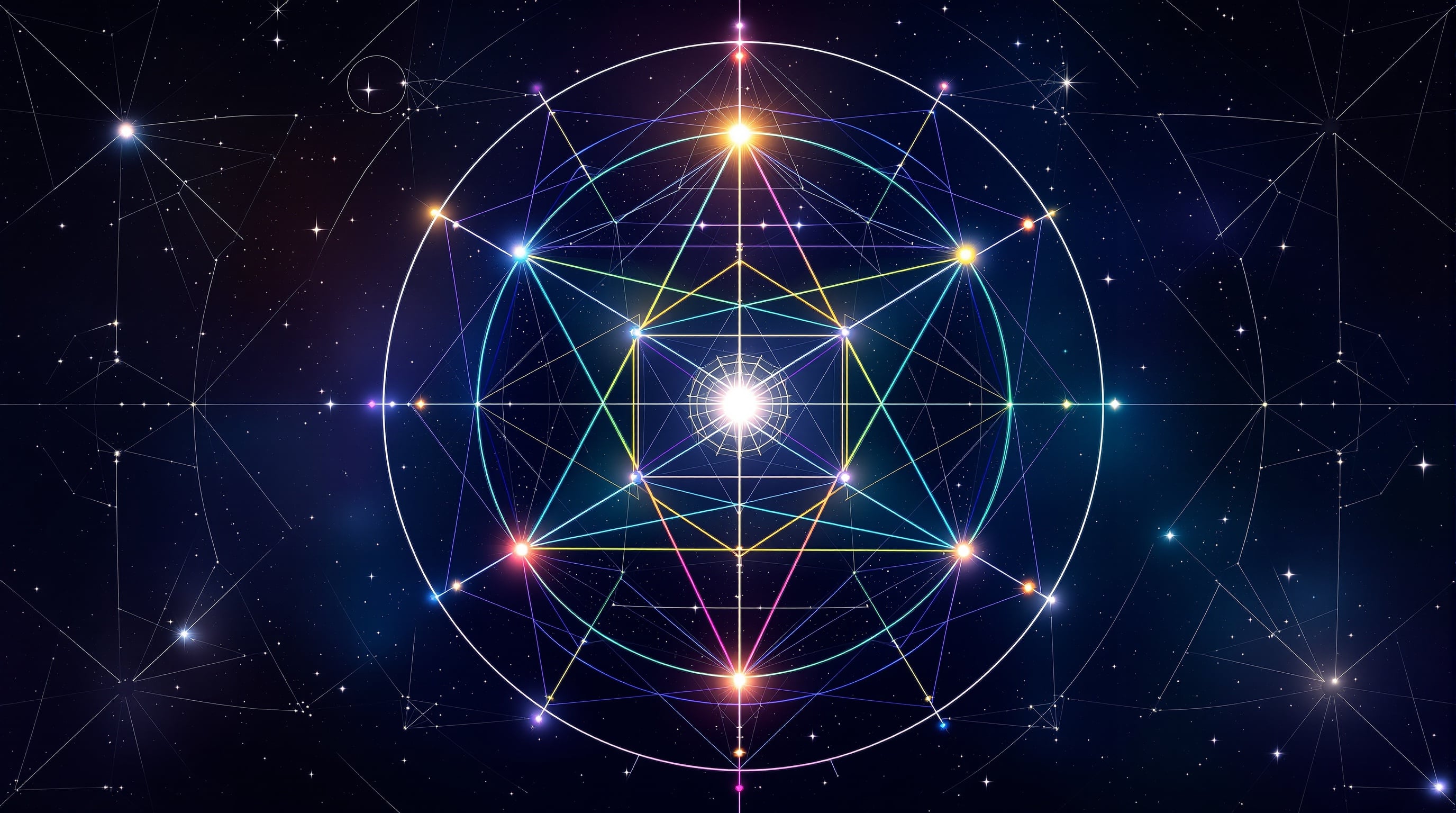
Aspects are the geometric angles formed between planets in your birth chart, creating a conversation between different parts of your psyche. While signs describe how planets express and houses show where they operate, aspects reveal how planets interact with each other. These angular relationships can be harmonious, challenging, or neutral, creating the dynamic tension and flow that animates your personality.
Imagine your birth chart as a cast of characters (the planets) speaking different languages (the signs) on various stages (the houses). The aspects are their dialogues—some characters work together beautifully, others create conflict, and some barely notice each other. These planetary conversations shape your inner dynamics, talents, challenges, and life patterns.
Aspects are calculated by measuring the degrees of separation between two planets along the 360-degree zodiac circle. Major aspects correspond to meaningful geometric divisions of the circle: conjunction (0°), sextile (60°), square (90°), trine (120°), and opposition (180°). Each aspect carries distinct energy and influences how the connected planets express in your life. Astrologers typically allow a few degrees of "orb" (margin of error) on either side of the exact angle.
The Major Aspects
Conjunction: A Fusion of Energies
A conjunction occurs when two planets occupy the same degree (or very close degrees) in the zodiac, creating a powerful fusion of their energies. This is the most potent aspect, as the planetary energies become inseparable, working as a unified force. The planets involved must learn to function together, for better or worse.
Conjunctions can be harmonious or challenging depending on the planets involved. A Venus-Jupiter conjunction is typically beneficial, bringing luck in love and abundance, as both planets are naturally harmonious. However, a Mars-Saturn conjunction can be difficult, as aggressive Mars conflicts with restrictive Saturn, potentially creating frustration or blocked action. The sign and house of the conjunction determine how this blended energy expresses.
In your natal chart, conjunctions represent areas where you have concentrated energy and natural intensity. You may be particularly talented or challenged in these areas. Conjunctions to your Sun, Moon, or Ascendant are especially significant, strongly coloring your core identity, emotions, or outward personality. People often identify strongly with the qualities of planets conjunct their personal points.
Sextile & Trine: Harmonious Flow
The sextile is a 60-degree angle between planets, typically connecting signs of complementary elements (Fire with Air, Earth with Water). This is a mildly harmonious aspect that creates opportunities and talents. Sextiles require some effort to activate—they're not as automatic as trines, but they provide potential for growth when you consciously engage them. A Mercury-Venus sextile, for example, grants talent in communication and artistic expression that develops when cultivated.
The trine is a 120-degree angle, connecting planets in the same element (Fire, Earth, Air, or Water). This is the most harmonious major aspect, creating natural flow and ease between planetary energies. Trines represent innate talents and areas of life where things come easily. A Sun-Jupiter trine brings natural optimism, luck, and confidence. However, because trines are so comfortable, they can sometimes indicate laziness or taking gifts for granted.
Both sextiles and trines are considered beneficial aspects, bringing opportunities, talents, and ease. In your chart, these aspects show where you have natural gifts and where life flows more smoothly. While challenges (squares and oppositions) often drive achievement through struggle, harmonious aspects provide the support and resources that help you succeed. The key is consciously developing these natural talents rather than squandering them through complacency.
Square & Opposition: Dynamic Tension
The square is a 90-degree angle between planets, typically connecting signs of the same modality (Cardinal, Fixed, or Mutable) but different elements. This is the most challenging major aspect, creating internal friction and conflict between planetary energies. Squares represent areas where you experience obstacles, frustration, and the need for integration. A Moon-Mars square might manifest as emotional reactivity and impulsive feelings that require conscious management.
While uncomfortable, squares are incredibly productive. The tension they create motivates growth and achievement. Many successful people have prominent squares in their charts—the internal pressure drives them to accomplish great things. Squares force you to develop skills and character through challenge. Over time, you learn to balance the conflicting energies, transforming the square from a problem into a source of dynamic power.
The opposition is a 180-degree angle with planets facing each other across the chart. This aspect creates awareness through contrast and often manifests in relationships, as you see the opposed planet reflected in others. Oppositions require balance and integration of seemingly incompatible energies. A Sun-Saturn opposition might manifest as tension between self-expression (Sun) and self-discipline (Saturn), or between your needs and others' expectations.
Oppositions create a seesaw effect—you may swing between one planet and the other, or project one end onto others. The growth challenge is finding the middle ground, honoring both planetary energies equally. While oppositions can create stress and relationship projection, they also bring awareness and the potential for powerful synthesis when both sides are integrated.
Minor Aspects: A Quick Look
Beyond the five major aspects, astrologers also consider minor aspects, though these are subtler in influence. The semi-sextile (30°) creates mild friction between adjacent signs, requiring adjustment. The semi-square (45°) and sesquiquadrate (135°) are mildly challenging, creating irritation. The quincunx or inconjunct (150°) connects incompatible signs, requiring constant adjustment and often relating to health issues.
Some astrologers also work with quintiles (72°) and bi-quintiles (144°), which are creative aspects associated with talent and gifts. These aspects divide the circle by five and are considered spiritually significant. However, for beginners, focusing on the five major aspects provides sufficient depth for meaningful chart interpretation.
How to Find Aspects in Your Birth Chart
On a printed birth chart, aspects are typically drawn as lines connecting planets in the center of the wheel. Different colored lines often represent different aspects: blue for trines and sextiles, red for squares and oppositions, green for conjunctions. This creates a geometric pattern in the chart's center that experienced astrologers can read at a glance.
Most astrology software also includes an aspect table or "aspectarian" that lists all aspects in your chart. This table shows each planetary pair and the type of aspect between them, along with the exact degree of orb. This makes it easy to identify all aspects without decoding the visual web of lines in the chart center.
When interpreting aspects, consider both the planets involved and the signs they occupy. A Venus-Mars square manifests differently in different signs. Venus in Pisces square Mars in Gemini creates different dynamics than Venus in Capricorn square Mars in Aries. The houses involved also matter—a 2nd house/8th house opposition emphasizes financial themes, while a 1st house/7th house opposition focuses on relationship dynamics.
Pay special attention to aspect patterns formed when three or more planets interact. A T-square involves two planets in opposition both squaring a third planet, creating intense focus and drive. A Grand Trine connects three planets in the same element, creating exceptional ease and talent but sometimes complacency. A Grand Cross involves four planets forming two oppositions and four squares, creating enormous tension that can produce remarkable achievements when channeled constructively.
Understanding aspects adds crucial dimension to chart interpretation. While signs and houses provide important information, aspects reveal the dynamic interplay between different facets of your personality. They show where you experience internal harmony or conflict, natural talents or challenges. By working consciously with your aspects—developing harmonious ones and integrating challenging ones—you transform your birth chart from a static symbol into a dynamic blueprint for personal growth and self-actualization.
Aspect Patterns: The Grand Trine
When three or more planets interact through aspects, they form patterns that add another layer of interpretation. The Grand Trine involves three planets approximately 120 degrees apart, forming an equilateral triangle connecting three signs of the same element. This is considered highly fortunate, indicating exceptional talent and ease in the element involved.
A Grand Trine in fire signs brings creative vitality, enthusiasm, and natural leadership. In earth signs, it provides material success, practical skills, and steady achievement. In air signs, it bestows intellectual brilliance, communication gifts, and social grace. In water signs, it grants emotional intelligence, intuitive ability, and healing capacity. People with Grand Trines often excel in their trine's element without much effort.
However, Grand Trines have a shadow side: complacency. Because energy flows so easily in the trine, there's little motivation to develop or challenge oneself. Many people with Grand Trines underachieve because life comes too easily in that area—why work hard when natural talent suffices? The most productive Grand Trines have at least one challenging aspect (square or opposition) to another planet, providing motivation to actually use the trine's gifts.
Aspect Patterns: The T-Square
The T-Square involves two planets in opposition (180°) both forming squares (90°) to a third planet. This creates intense dynamic tension and motivation. The planet receiving both squares (called the apex planet) becomes a focal point for resolving the opposition's tension. T-Squares create high achievement through challenge—they're uncomfortable but productive.
People with T-Squares often feel driven by inner tension and conflict. The opposition creates awareness of two competing needs or perspectives, while the apex planet must somehow integrate or mediate between them. A T-Square involving Sun opposite Moon (identity versus emotions) both square Saturn (authority/limitation) might manifest as feeling torn between personal needs and responsibilities, requiring mature integration of all three.
The empty leg—the point opposite the apex planet—represents the "release point" for T-Square tension. Developing the qualities of that empty point's sign and house can provide relief and resolution. If your apex is in early Capricorn, the release point is early Cancer—finding emotional security and home base can ease the pressure of your T-Square.
Aspect Patterns: The Grand Cross
The Grand Cross (or Grand Square) involves four planets forming two oppositions and four squares, creating a square pattern with planets at all four points. This is the most challenging aspect pattern, generating enormous tension from multiple directions simultaneously. People with Grand Crosses often experience life as a constant series of obstacles and conflicts requiring navigation.
However, Grand Crosses can produce remarkable achievements. The intense pressure, when channeled constructively, creates unstoppable drive and accomplishment. Many successful people have Grand Crosses—the constant challenge motivates them to achieve what others might find impossible. The key is learning to work with the Cross rather than being overwhelmed by it.
Grand Crosses come in four types based on modality: Cardinal (action-oriented, initiating, leadership-focused), Fixed (stubborn, determined, unchanging), and Mutable (scattered, adaptable, pulled in many directions). Each type creates distinct challenges and requires different strategies for integration and productive expression.
Orbs: How Exact Must Aspects Be?
Aspects are most powerful when exact (zero degree orb) but remain influential within a certain number of degrees on either side—called the orb of influence. Astrologers disagree on appropriate orbs, with traditional astrology using tighter orbs (often just a few degrees) and modern astrology sometimes allowing wider orbs (up to 10 degrees for major aspects involving luminaries).
Generally, closer orbs mean stronger aspect influence. An aspect within one degree of exact is considerably more powerful than one with a five-degree orb. The Sun and Moon typically receive wider orbs (up to 10 degrees) due to their importance, while minor aspects and asteroids receive tighter orbs (2-3 degrees). Personal preference and astrological tradition influence orb choices.
Applying versus separating aspects also matter. An applying aspect is growing closer to exact and represents developing energy. A separating aspect is moving past exact and represents waning energy. In predictive astrology, applying aspects indicate approaching events or developing situations, while separating aspects suggest past influences still being processed.
Aspect Application in Daily Life
Understanding aspects in your natal chart is just the beginning—recognizing how they operate in daily life brings astrology from theory to practice. Notice when you experience the tension of your natal squares or the ease of your trines. Do certain situations trigger your Mars-Pluto square's intensity? Does your Venus-Jupiter trine make socializing effortless? Conscious awareness of your aspects helps you work with them intentionally rather than unconsciously acting them out.