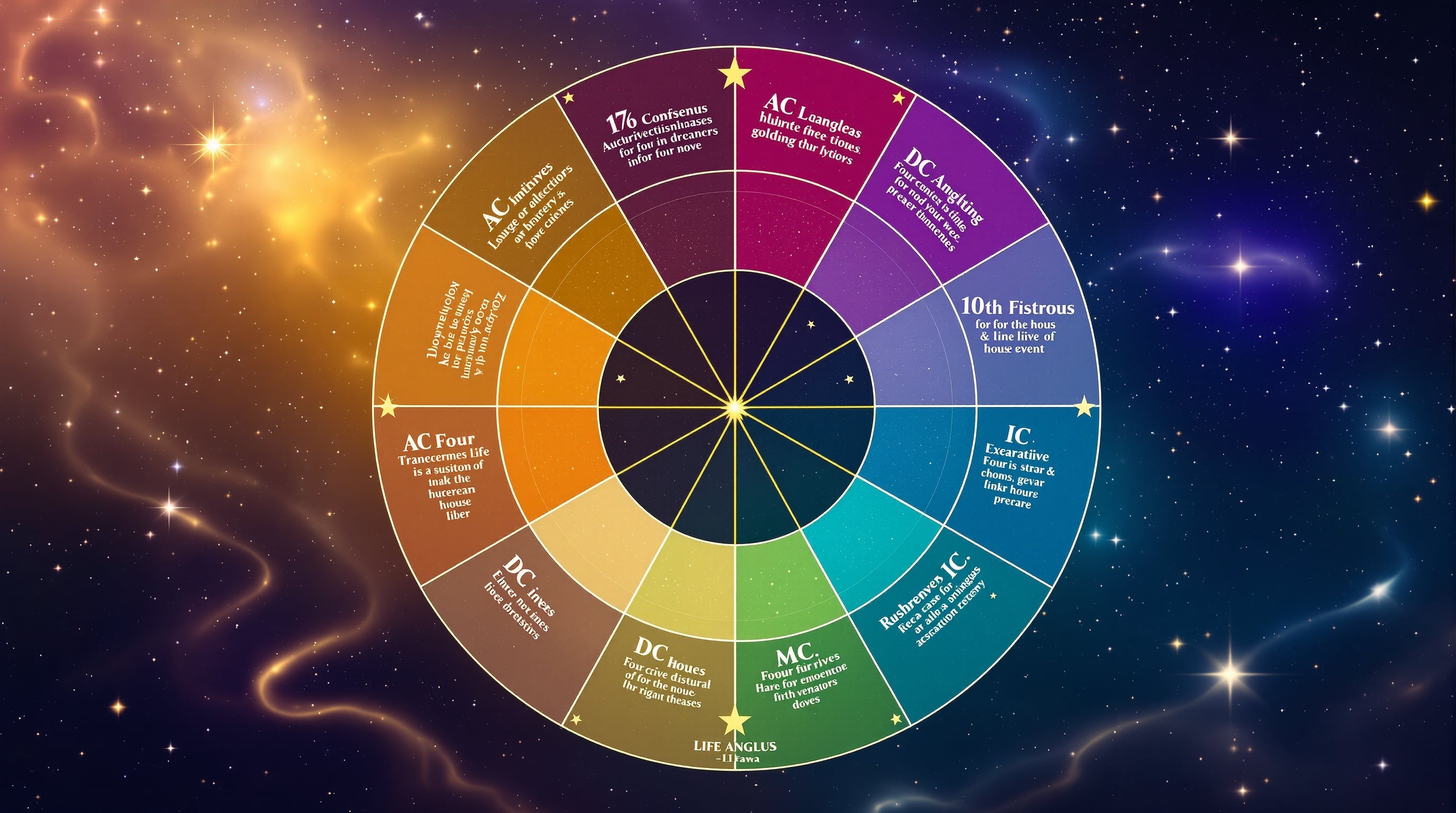
Understanding the Angles of the Chart (AC, DC, MC, IC)
Before exploring the twelve houses, it's essential to understand the four angles—the most sensitive points in any birth chart. These cardinal directions of your astrological map create the framework for the house system and represent critical life areas. The angles are the Ascendant (AC), Descendant (DC), Midheaven (MC), and Imum Coeli (IC), and they mark the cusps of the 1st, 7th, 10th, and 4th houses respectively.
The Ascendant (AC), or Rising sign, is the zodiac sign rising on the eastern horizon at your birth. It represents your persona, physical appearance, and approach to life. This is how you instinctively meet the world and how others perceive you initially. The Ascendant begins the 1st house and sets the tone for your entire chart structure.
Directly opposite the Ascendant is the Descendant (DC), marking the cusp of the 7th house. This point represents partnerships, marriage, and how you relate to others one-on-one. The Descendant shows the qualities you seek in partners and may project onto others—often traits opposite to your Ascendant that you need to integrate.
The Midheaven (MC), from the Latin "Medium Coeli" meaning "middle of the sky," is the highest point in your chart. It represents your public reputation, career aspirations, and life direction. The MC is the cusp of the 10th house and shows how you want to be known in the world. This is your professional persona and ultimate achievements.
The Imum Coeli (IC), meaning "bottom of the sky," is opposite the Midheaven and marks the 4th house cusp. This point represents your roots, family, home, and private life. The IC is your foundation—where you come from and what makes you feel secure. It's often associated with your ancestry and the emotional base from which you operate.
The First Six Houses: The Personal Realm
1st House (House of Self): Beginning at the Ascendant, the 1st house represents your physical body, personality, and how you initiate action. This house describes your approach to life, first impressions, and personal style. Planets here strongly influence your identity and self-expression. An active 1st house suggests a strong, defined personality, while an empty 1st house (containing no planets) doesn't diminish your identity—it simply means you express your Rising sign more purely.
2nd House (House of Values and Possessions): This house governs your material resources, money, possessions, and personal values. It shows how you earn income and what you consider valuable beyond money—your talents, self-worth, and relationship with the material world. The 2nd house reveals your attitude toward security and what makes you feel resourced and stable.
3rd House (House of Communication): The 3rd house rules everyday communication, learning, siblings, neighbors, and short trips. It describes your thinking style, how you process information, and your relationship with your immediate environment. This house governs writing, speaking, teaching, and all forms of information exchange. Planets here emphasize intellectual curiosity and social connection.
4th House (House of Home and Family): Beginning at the IC, the 4th house represents your home, family, roots, and emotional foundation. It describes your relationship with parents (particularly the nurturing parent), your ancestry, and what makes you feel safe. This house also governs real estate, your private life, and the end of matters. It's your inner sanctuary and psychological base.
5th House (House of Pleasure and Creativity): This house governs creativity, romance, children, play, and self-expression. It represents what brings you joy, your hobbies, artistic pursuits, and recreational activities. The 5th house shows how you express your unique essence and take risks. It's associated with gambling, speculation, and all activities done purely for pleasure rather than necessity.
6th House (House of Health and Service): The 6th house rules daily work, health, habits, and service. It describes your work environment (not career, which is 10th house), daily routines, and relationship with wellness. This house governs pets, employees, and how you serve others. Planets here emphasize the importance of healthy habits, meaningful work, and practical service.
The Last Six Houses: The Interpersonal Realm
7th House (House of Partnerships): Beginning at the Descendant, the 7th house represents committed partnerships, marriage, business relationships, and open enemies. It shows what you seek in a partner and how you approach committed relationships. This house is the "you" reflected through intimate others. The sign on your Descendant often describes qualities you admire and seek to unite with through partnership.
8th House (House of Transformation): This intense house governs shared resources, intimacy, death, rebirth, and transformation. It rules inheritances, taxes, loans, and other people's money. The 8th house represents psychological depth, sexuality, and the mysteries of life. It's where we merge with others on the deepest levels and confront our shadows. Planets here indicate profound transformative capacity.
9th House (House of Philosophy): The 9th house rules higher education, philosophy, religion, long-distance travel, and the search for meaning. It represents your belief systems, moral code, and how you expand your worldview. This house governs publishing, teaching at higher levels, and encounters with foreign cultures. It's where you seek truth and wisdom beyond everyday experience.
10th House (House of Career): Beginning at the Midheaven, the 10th house represents your career, public reputation, and life direction. It describes your professional achievements, status, and how you want to be recognized in the world. This house shows your relationship with authority and your own authority in the public sphere. It's your legacy and contribution to society.
11th House (House of Community): This house governs friendships, groups, social causes, and your hopes and dreams for the future. It represents your social circle, community involvement, and humanitarian concerns. The 11th house shows where you find your tribe and how you contribute to collective goals. It's associated with technology, innovation, and progressive ideals.
12th House (House of the Unconscious): The final house represents the unconscious mind, spirituality, hidden matters, and self-undoing. It governs isolation, hospitals, prisons, monasteries, and all places of retreat. The 12th house contains what's hidden from conscious awareness—both gifts and challenges. It's associated with compassion, sacrifice, and connection to the divine. Planets here work subtly, influencing you from behind the scenes.
How to Find the Houses in Your Chart
On your birth chart wheel, the houses are numbered 1-12, typically in a counterclockwise direction. The 1st house always begins at the 9 o'clock position (the Ascendant) and continues counterclockwise. The exact size of each house varies depending on the house system used (Placidus, Equal, Whole Sign, etc.) and your birth location, though Equal house systems give each house exactly 30 degrees.
Each house cusp (beginning point) falls in a particular zodiac sign, which colors that house's expression. For example, if your 2nd house cusp is in Gemini, you might earn money through communication or have fluctuating income. The sign on each house cusp provides clues about how you experience that life area.
Note that houses can be empty (containing no planets), and this is completely normal. An empty house doesn't mean that life area is unimportant—it simply means you experience those themes through the natural expression of the sign on that house cusp and its ruling planet's placement. Most people have several empty houses, as there are twelve houses but only ten planets (including Sun and Moon).
Planets in the Houses: Adding More Detail
When planets occupy a house, they activate that life area, bringing focus, energy, and events. The planet describes what is active, the sign describes how it operates, and the house describes where in life it manifests. For example, Venus in Aries in the 3rd house suggests passionate, direct communication (Venus in Aries) expressed through writing, speaking, or sibling relationships (3rd house).
Multiple planets in one house create a stellium, concentrating significant life energy in that area. Someone with a stellium in the 7th house will find relationships absolutely central to their life journey, while a stellium in the 10th house indicates career will dominate their focus. The house containing your Sun is where you're meant to shine and develop your identity.
The ruling planet of each house (determined by the sign on the cusp) also provides information. If your 4th house cusp is in Leo, the Sun becomes your 4th house ruler. The Sun's placement by sign and house then tells you more about home and family matters. This technique, called "house rulership," adds sophisticated layers to chart interpretation.
Understanding the houses is crucial for practical astrology. While signs and planets describe character, houses reveal where that character expresses in real life. The houses transform abstract archetypes into concrete experiences. By studying which houses are emphasized in your chart and what planets activate them, you gain a roadmap of your life's most significant areas of development, challenge, and growth. The twelve houses are the stages upon which your cosmic drama unfolds.
Empty Houses: What They Mean
Many beginning astrologers worry when they discover empty houses in their chart. "Does my empty 7th house mean I'll never have relationships?" "My empty 10th house—will I fail in career?" The answer is emphatically no. Empty houses are completely normal and don't indicate lack or failure in those life areas. Most people have several empty houses since there are twelve houses but only ten planets (including Sun and Moon).
An empty house simply means you experience that life area through the natural expression of its sign and through the house's ruler (the planet ruling the sign on the cusp). If your 7th house is empty but has Gemini on the cusp, you experience partnerships through Gemini qualities—communication, variety, mental connection—and by examining Mercury's (Gemini's ruler) placement in your chart. Mercury in your 3rd house would suggest relationships develop through communication and local connections.
Houses with planets are emphasized life areas requiring conscious development and offering potential for significant experience. Empty houses are areas you may handle naturally without needing focused attention, or areas that simply aren't primary life themes. Someone with a stellium in the 10th house will be career-focused, while their empty 4th house suggests home life flows without demanding constant attention. Neither is better—they're simply different life designs.
Intercepted Signs and Houses
In some house systems and at certain latitudes, entire zodiac signs can be "intercepted"—contained completely within a house without touching any house cusp. When a sign is intercepted, the opposite sign is also intercepted in the opposite house. This creates houses with two signs on their cusps and houses with intercepted signs that don't appear on any cusp.
Intercepted signs and any planets within them often indicate energies that are harder to access or express. You possess these qualities but may struggle to bring them forth, especially earlier in life. If Scorpio is intercepted in your 3rd house, you might have difficulty expressing deep, intense thoughts in everyday communication, though these qualities are within you seeking expression. Working consciously with intercepted signs often becomes a life theme—learning to access and integrate these "locked" energies.
Not all house systems produce interceptions. Equal house and Whole Sign house systems have no interceptions, while Placidus (the most common system) and Koch systems do. Some astrologers consider interceptions significant, while others use house systems that avoid them entirely. If you have interceptions, pay special attention to any planets in intercepted signs—they require extra effort to integrate but often represent powerful gifts once unlocked.
Angular, Succedent, and Cadent Houses
The twelve houses are grouped into three categories based on their relationship to the four angles: angular (1st, 4th, 7th, 10th), succedent (2nd, 5th, 8th, 11th), and cadent (3rd, 6th, 9th, 12th). This classification reveals each house's relative strength and type of activity.
Angular houses are action-oriented and powerful. Planets here have the strongest expression and greatest impact on your life. These houses mark the four directions of your chart: self (1st), home (4th), others (7th), and career (10th). Angular planets drive your life and demand expression—they're impossible to ignore.
Succedent houses are resource-oriented and stable. They follow angular houses and consolidate the angular houses' initiatives. The 2nd house builds resources from 1st house identity, the 5th house creates from 4th house foundation, the 8th house deepens 7th house relationships, and the 11th house socializes 10th house achievements. Succedent houses provide staying power and material substance.
Cadent houses are learning-oriented and flexible. They prepare for the next angular house. The 3rd house gathers information, the 6th house refines skills, the 9th house seeks meaning, and the 12th house releases and spiritualizes. Cadent planets indicate mental and spiritual activity rather than obvious outer-world impact. A chart with many cadent planets suggests an intellectual, adaptable person who may not seek the spotlight but serves important behind-the-scenes roles.